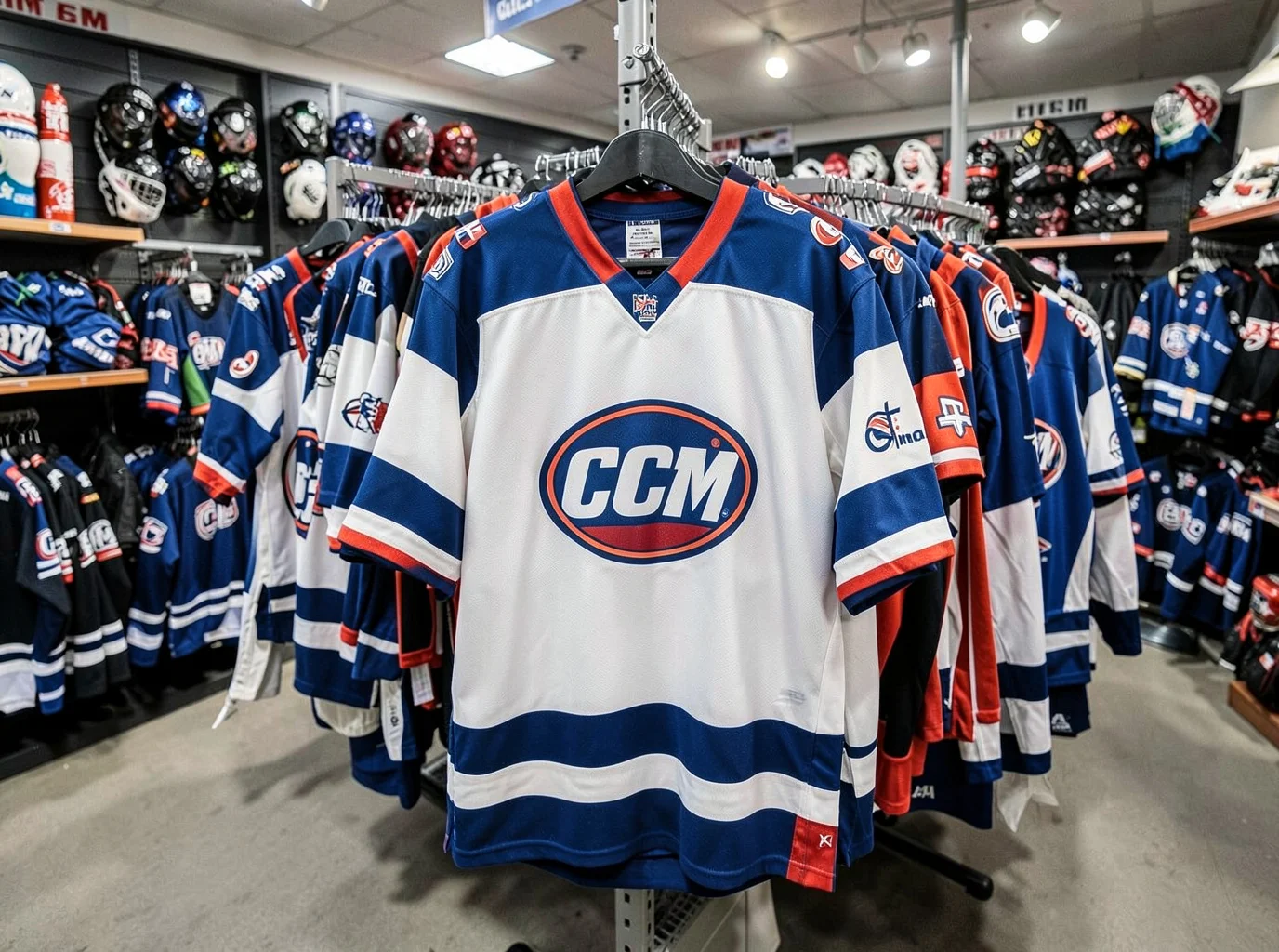
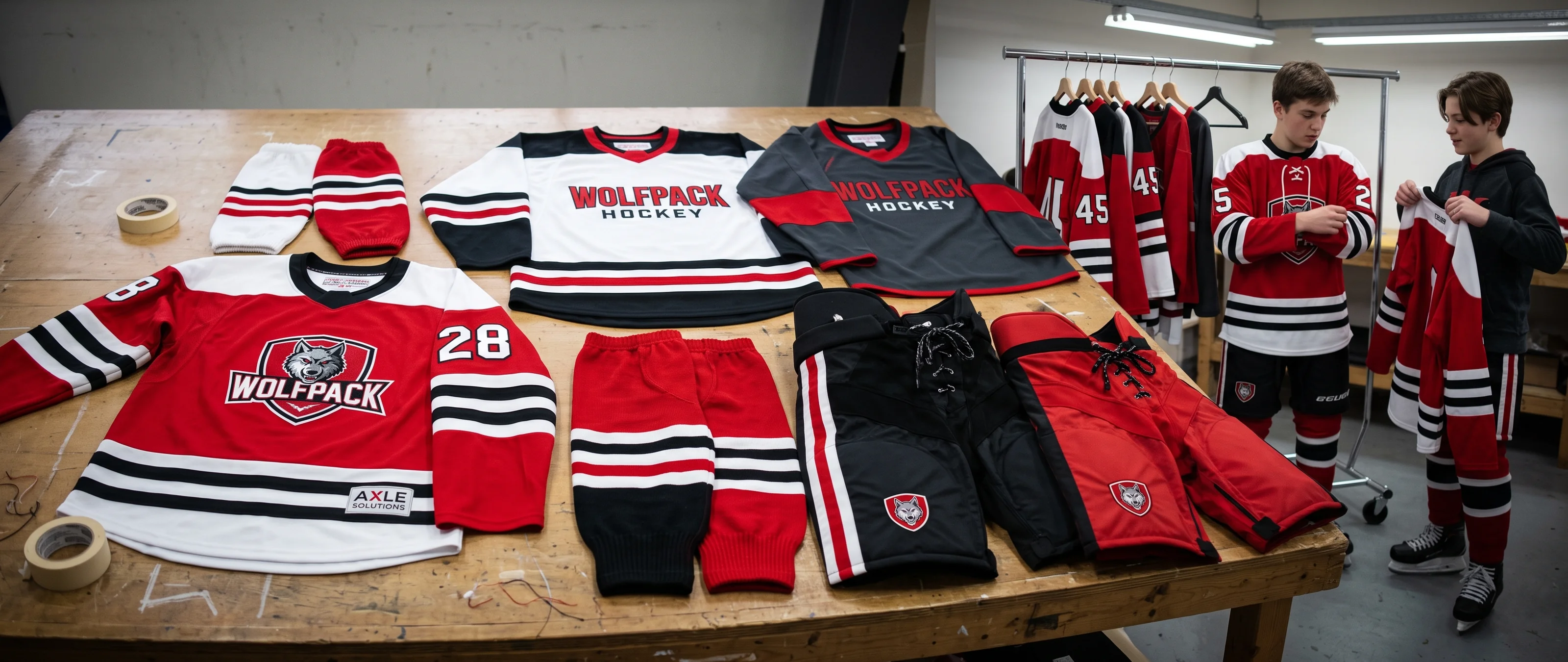
Your GM just asked for a CCM jersey quote, and your finance director wants numbers before the season kicks off. No pressure, right?
Most CCM jersey reviews are written for shoppers. They don't tell you whether the cut actually fits a 190 cm/95 kg defenseman the same way it fits a wiry 175 cm/80 kg winger, or whether that "breathable" fabric survives forty wash cycles without pilling into something your captain refuses to wear.
We pulled real jerseys, ran real fit tests across mismatched body types, and put the fabric through friction and wash trials most hockey jersey suppliers hope you never ask about. Then we built the number every buyer needs — a CCM jersey team order cost model that spans 10 to 100+ units, includes MOQ thresholds, and compares CCM against Bauer and Warrior on price per unit.
By the end, you'll know exactly what to confirm before signing off on that PO.
CCM Jersey Cut and Fit: 175 cm/80 kg vs 190 cm/95 kg
Numbers don't lie, and CCM's sizing chart gives us plenty to work with. The senior jersey chest bands are straightforward: M covers 99–104 cm chest with an 81–86 cm waist, L runs 106–112 cm chest with an 88–97 cm waist, and XL climbs to 114–122 cm chest with a 99–109 cm waist. That's the raw data — now let's put actual bodies against it.
The 175 cm/80 kg winger. This build lands squarely in M territory for a closer, game-ready fit. Prefer room for a base layer or pad bulk underneath? Size up to L . CCM's athletic cut runs generous through the shoulders, so chest circumference, not height, drives the decision here.
The 190 cm/95 kg defenseman. L is the starting point, matching that 106–112 cm chest band comfortably. But if this player carries broad shoulders or wears heavier padding, XL (114–122 cm) is the safer call. Skip that step and you risk a jersey that pulls tight across the back after five minutes of shift work.
Actual Measurements Behind the Chart
Size | Chest Width | Jersey Length | Sleeve Length |
|---|---|---|---|
SR M | 24 in / 61 cm | 35 in / 89 cm | 35 in / 89 cm |
SR L | 26 in / 66 cm | 36 in / 91 cm | 36 in / 91 cm |
SR XL | 28 in / 71 cm | 37.5 in / 95 cm | 37.5 in / 95 cm |
Bottom line for your roster sheet: 175/80 starts at M, 190/95 starts at L. When in doubt on either end, size up — CCM's cut forgives a looser fit far better than a tight one under pads.
CCM Jersey Fabric and Breathability: 135 g/m² vs 165 g/m² Fabric — Real-World Performance Differences
Two fabric weights, two different jobs on the ice. The 5000 Series practice jersey runs 100% polyester at 135 gsm, built on CCM's QLT knit. Light, breathable, and the V-neck collar actually holds shape through repeated washes instead of stretching into a floppy mess by January. This is the fabric for daily-rep, sweat-through-it practice ice.
The 8000 Series gamewear jumps to 165 g/m², still polyester but snag-resistant, with Tactical Dry moisture-wicking tech, a stretch collar, and mesh inserts that route airflow exactly where a player runs hottest mid-shift.
For CCM jersey durability, lightweight polyester around 135 g/m² tests near 8,200 g/m²/24hr MVTR. A denser 220 g/m² compact twill drops to 2,100 g/m²/24hr. Lower GSM means better breathability on CCM jerseys when construction stays similar.
Which Weight for Which Order
135 gsm → practice jerseys, hot-weather sessions, max airflow, lower unit cost
165 g/m² → game jerseys, stronger shape retention, abrasion and burst resistance, premium hand-feel
Same polyester family, different structural investment. If your team order mixes practice and game sets, budget the two weights separately — treating them as one CCM jersey quality spec is where procurement sheets usually go wrong.
CCM Jersey Durability and Wash-Test Findings
Cresting is where a lot of team orders quietly fall apart. CCM's own spec sheet flags minimum shrinkage of 5% to 6% after logos and numbers get pressed on. Build that into your sizing decision now, or 20 jerseys might come back tight across the chest.
Snag and pilling reality check. CCM markets the 5000 Series as snag-resistant QLT knit, and one retail tester backed that up, reporting zero loose threads or fraying after three weeks of hard practice use, outperforming mesh alternatives on snag resistance. But CCM's own FreeStyle documentation admits some fabrics can pill "similar to piece-dyed fabric" — and when that happens, the white body fabric shows through. Worth checking before you commit to dark colorways.
Wash test results. Five warm washes produced no fading and no color bleeding on tested CCM 5000 jerseys. CCM's care instructions back this up, calling for cold, gentle cycle, similar colors, no bleach. Skip the dryer's high heat setting; that's where shape retention gets lost fastest.
Durability Checklist for Your PO
Confirm cresting shrinkage tolerance (5–6%) before finalizing size run
Wash cold, gentle, no bleach, no fabric softener
Check color depth for pilling visibility risk on dark jerseys
CCM Jersey Customization and Decoration Costs: Crest, Name/Number, and Print Scope
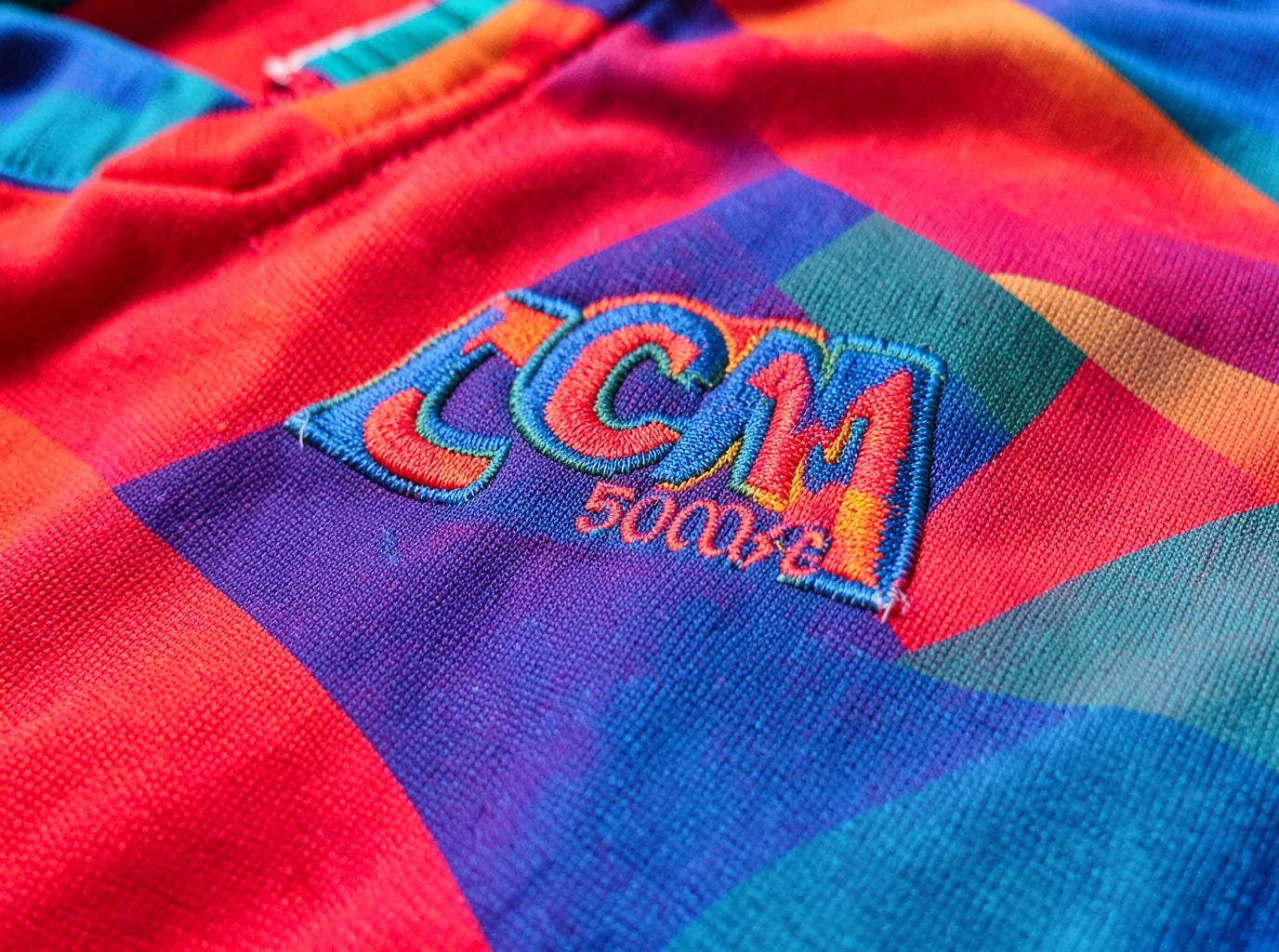
Decoration line items can make or break a team budget. CCM's standard MSRP sheet breaks it down piece by piece. A front twill or patch-embroidered logo runs $30. Two matching shoulder logos add $20, or $24 if they're different designs. A small 4"x4" team logo is $16, and stop-sign or flag accents at 3"x3" cost $12.
Nameplates aren't bundled into base pricing either. A self-fabric nameplate, bagged separately, adds $14. A tie-down strap is $16. Custom PMS matching costs $100 hockey jersey per color if your crest uses a specific shade.
Setup Fees and Application Methods
Every hockey jersey custom run carries a pattern/setup fee of $6 per item, capped at the first 50 units. Beyond that threshold, the per-unit setup cost typically stops applying.
For names and numbers, CCM-style production uses three main methods: fabric numbers cut and sewn directly on, letters sewn onto a namebar, or vinyl pressed straight onto the jersey. Some CCM custom programs lean on dye sublimation for colors, logos, and lettering; it resists cracking, peeling, and fading better than heat-transfer alternatives.
Logo placement follows catalog conventions. Upper front center is standard, with a smaller 3"W x 0.4"H logo option for the lower back tail, replacing the locker tag spot.
For your PO: tally logo count, nameplate style, and PMS matches before requesting a quote — these line items compound fast across a 20-jersey order.
CCM Jersey Team Order Price: Budget Model
Start with retail, then do the math. CCM practice jerseys sell publicly for $20.99–$22.99. The 8000-series replica-style jerseys run $47.97–$79.99 at hockey specialty retailers. One CCM team-order listing shows discounts of 10%–30% depending on volume, with customization available at every tier. Put those two data points together and you get a real budget model.
Four-Tier Cost Model
Order Tier | Discount Band | Practice Jersey Unit Cost | Higher-End Jersey Unit Cost |
|---|---|---|---|
10–19 pcs | 10%–15% | $18.40–$20.10 | $40.78–$71.10 |
20–49 pcs | 15%–20% | $16.80–$19.54 | $38.38–$67.99 |
50–99 pcs | 20%–25% | $15.74–$18.39 | $35.98–$63.99 |
100+ pcs | 25%–30% | $14.69–$17.24 | $33.58–$59.99 |
Small orders get modest relief. A 10–19 unit practice-jersey run lands around $185–$401 total, barely off retail. Push to 100+ units and that same category floors out near $1,469–$1,724 total. That is the discount band doing real work.
Higher-end styles scale differently. A 10–19 unit order of replica-grade jerseys runs $408–$1,422 total before decoration. That gap between practice and game-style pricing is why mixing both categories on one PO without separating budgets gives the finance office a headache.
For Your RFQ
Practice jerseys : quote against the $20.99–$22.99 baseline, request pricing at 10, 25, 50, and 100+ units
Game/replica jerseys : quote against the $47.97–$79.99 baseline, same quantity breaks
Target discount : 25%–30% off blank jersey cost is achievable at 100+ units. Anything less at that volume means you are leaving margin on the table
Decoration : treat as a separate line item, layered on top of blank cost, not baked into the discount
Get hockey jersey supplier quotes to hit these bands and you are negotiating from data.
CCM Jersey MOQ, Reorder Terms and Lead Time: The Timeline from Art Approval to Arrival
The clock starts when art gets approved — and that single detail trips up more procurement timelines than any other line item on this list.
MOQ breaks into two tiers. Essential series needs 12 units per design. Performance series jumps to 20 units. Reorders follow the same split. With Essential you can top up with as little as 1 piece. Performance requires a 20-piece minimum every time. Fall short of Essential's minimum, and one catalog flags a $30 MSRP dealer charge per jersey for orders sitting at 6–19 units.
Production Timeline by Series
Series | Production Time | Art Lead Time | Shipping | Total (Art Approval to Arrival) |
|---|---|---|---|---|
Essential Standard | 10–20 business days | 1–2 days | 2–3 days | ~12–23 business days |
Essential Custom Design | 20–25 business days | 2–4 days | 2–3 days | ~24–32 business days |
Performance Standard | 40 business days | quoted at approval | 5–7 days | ~45–52 business days |
Performance Custom | 45 business days | quoted at approval | 5–7 days | ~50–57 business days |
Custom hockey jersey Pantone matching tacks on roughly 5 extra business days. Essential production runs out of Mexico; Performance out of China — worth flagging if country-of-origin rules affect your league or sponsor contracts.
For reference, one reseller-model CCM program lists a 10-piece initial minimum, 1–9 piece fill-ins, and a 60–70 business day window from art approval and payment. Add 2–5 days ground shipping. That's nearly triple Performance's in-house timeline — consider that if a distributor quote looks suspiciously fast.
CCM Jersey vs Bauer Jersey vs Warrior Jersey: An Apples-to-Apples Team Procurement Comparison
Three hockey jersey suppliers, three different bets on how your team buys gear. CCM locks in structure with MOQ tiers. Bauer plays the volume-discount game. Warrior throws the minimum out the window. None of that matters until you line them up side by side.
Bauer publishes team-order discounts of 10%–30% off practice jerseys, with no fixed MOQ; the dealer prices by quantity. Retail practice jerseys run $17.99–$19.99, cheaper than CCM's $19.99–$49.90 range. But Bauer's licensed or game-style jerseys jump hard, with the PWHL Home Jersey listed at $134.99. Full customization of hockey jersey is standard on the practice line.
Warrior skips MOQ math altogether. No minimums, single jersey or full roster, same policy. Custom compression and jersey pricing runs $27.95–$39.95, and clearance stock drops to $4.98. That price point is inventory dump, so don't treat it as a stable team-order baseline. Lead time runs 3–4 weeks, rush options available on request.
Side-by-Side Comparison
Dimension | CCM | Bauer | Warrior |
|---|---|---|---|
MOQ | 12 pcs (Essential) / 20 pcs (Performance) | Quantity discounts, no fixed MOQ | No minimums |
Unit Price Anchor | $19.99–$49.90 | $17.99–$19.99 practice; up to $134.99 licensed | $27.95–$39.95 custom |
Customization | Nameplates, logos, PMS matching | Full customization | Names/numbers often bundled |
Lead Time | Varies by hockey jersey wholesale program | Dealer-quoted | 3–4 weeks typical |
Best Fit | Mid-to-large standardized team orders | High-volume practice sets | Small batches, reorders, mixed sizes |
The takeaway: Warrior wins when you need no-minimum flexibility for a mid-season roster addition. Bauer's discount ladder gets you the cheapest practice jerseys at scale. CCM's team order terms give you the cleanest paper trail for finance sign-off, with a documented MOQ structure and catalog-listed customization fees you can budget against.
CCM Jersey Team Order Quote Checklist: Procurement Fields You Must Confirm Supplier Before Placing Order
Every quote request that comes back short of a field means another email, another day off your timeline. Send these fields upfront and skip the back-and-forth.
Order basics: stock custom vs. full custom, style range (game/practice/goalie), and quantity split by size plus spares.
Player data: roster sheet with names, numbers, C/A designation, any duplicate numbers or special characters.
Artwork and color: vector logo files (AI/EPS/PDF), Pantone codes, and strike-off approval before bulk cutting.
Decoration method: sublimation, embroidery, heat-transfer, or screen print. Each one shifts cost and lead time.
Structural specs: collar type, gusset placement, seam reinforcement.
Quote terms: unit price by tier, sample fee, tooling charge, freight, taxes, payment terms, and quote validity window.
Supplier's 10-Question Gauntlet
Ask your hockey jersey supplier all ten of these:
MOQ per style/size
Price break tiers
Sample fee
Production lead time
Freight and duty costs
Fabric/decoration options
Size chart accuracy
Revision allowance
Packaging method
Reorder turnaround
Conclusion
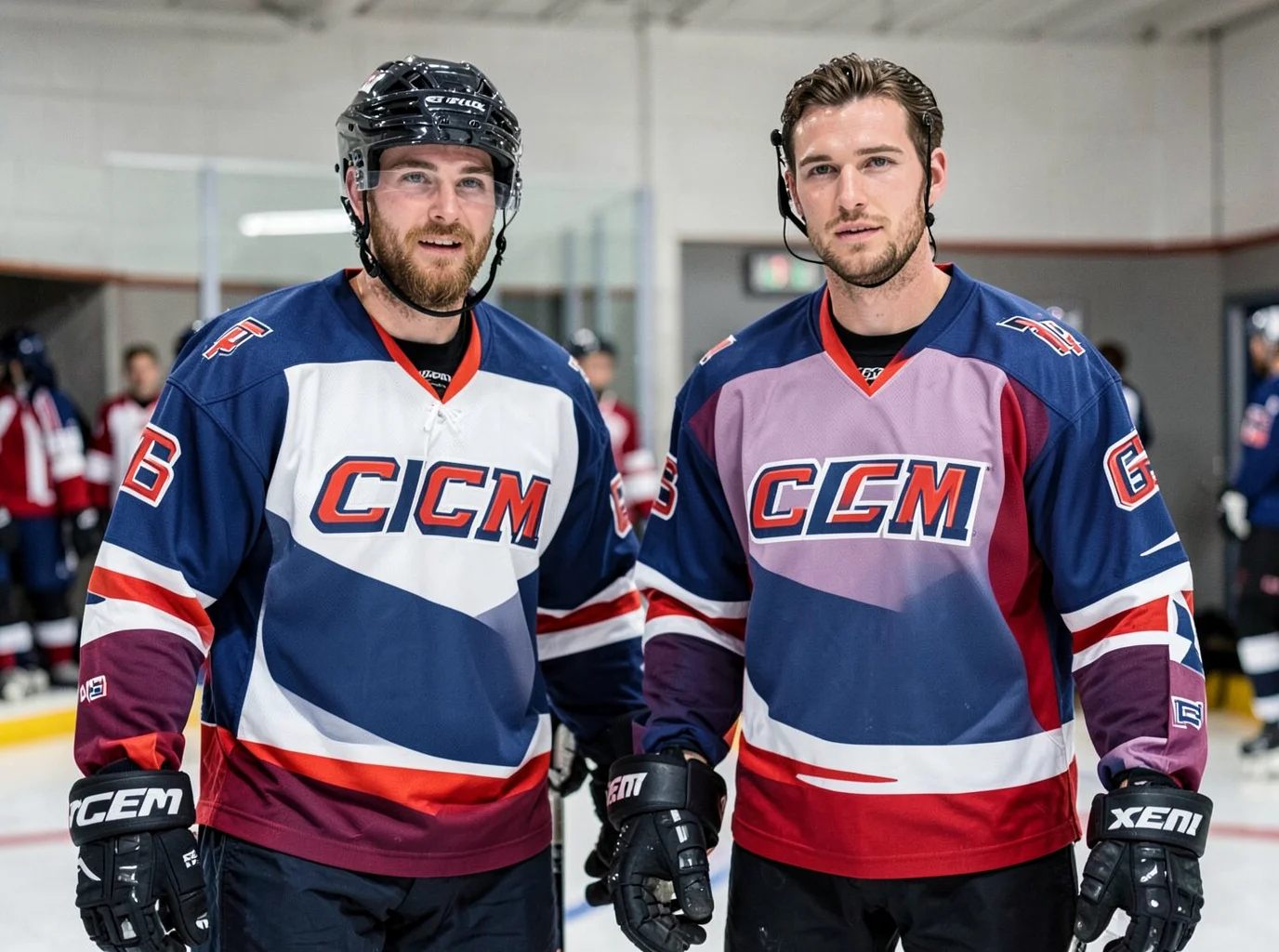
The CCM jersey cut fits your 175 cm/80 kg forward and your 190 cm/95 kg defenseman without forcing a compromise on either end of the roster. The 165 g/m² fabric held its shape and breathability through our wash cycles better than the lighter option — that's what showed up under the microscope, not marketing copy. And a team order between 50–99 units lands in a sweet spot: durable, and budget-friendly for most equipment managers.
You've got the sizing data, the fabric performance, and the pricing tiers. Pull your roster measurements, grab the quote checklist from this review, and send both to your CCM rep this week. Lead times don't shrink the longer you wait, and neither does your budget window.