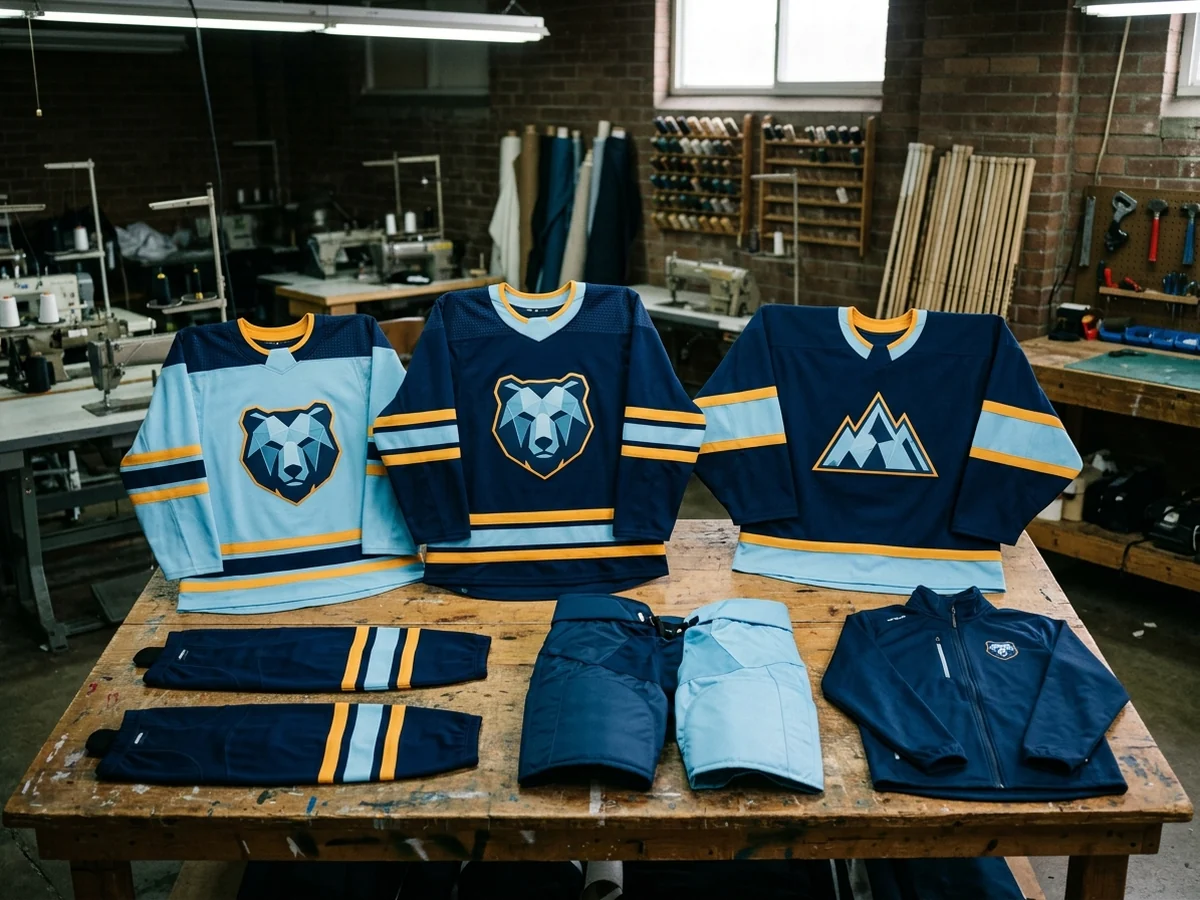
A hockey jersey rarely wears out on the ice. It wears out in the laundry: in hot dryers, in overloaded machines, in a damp bag left in a car overnight, and in washes where hook-and-loop straps chew at twill edges. For a team manager, a club equipment volunteer or a school program, the difference between a set that still looks sharp in the final month of the season and one that looks tired by midseason is usually the wash routine, not the garment.
This guide is the routine we suggest to buyers once their order ships. It covers the decoration routes on a modern hockey jersey, the socks and pant shells that go into the same bag, and the checks worth doing before a set is packed away. One rule sits above everything below: the sewn-in care label on your specific order takes precedence, because it is written for the exact fabric and thread in that order.
Why Hockey Kit Wears Out in the Laundry, Not on the Ice
Hockey apparel is almost always polyester: air knit or double-knit bodies, mesh panels, and polyester twill for sewn decoration. Polyester is strong and quick-drying, but it has two weak points in the wash. Heat softens it and the adhesives used on some decoration, and friction pills and frays it. A game jersey worn once a week sees little of either. A practice jersey that goes through the machine after nearly every session sees both, constantly, which is why training garments are specified differently from game jerseys in the first place (see custom hockey practice jerseys for how that build differs).
Sweat and moisture are the third factor. A jersey that sits wet in a bag starts to smell because bacteria grow in the damp fabric, and aggressive washing to remove that smell then does more damage than the game did. Most of the care routine below is about removing those three stresses: heat, friction and trapped moisture.
Sort the Load by Decoration, Not Only by Color
Sorting by color keeps dark dye away from white jerseys. Sorting by decoration keeps the most fragile finish away from the conditions that damage it. A mixed team laundry usually contains four kinds of items.

Sublimated jerseys
On a sublimated hockey jersey the color sits inside the polyester fiber rather than on top of it, so there is no print layer to crack or peel. That makes sublimated sets the most forgiving in the wash. The fabric itself still dislikes high heat, so the same drying rule applies to them as to everything else.
Tackle twill and embroidered jerseys
Twill numbers, names and crests are cut from woven fabric and stitched down around the edge; embroidery is built entirely from thread. Both are durable, and both are raised. Turn these jerseys inside out so the decoration faces away from the drum, and never wash them in the same load as items with open hook-and-loop fasteners, which snag stitches and lift twill edges. The tackle twill and embroidered hockey jersey page covers how the construction is built.
Heat-transfer names and numbers
Pressed-on numbers and names are bonded with heat, which makes heat the thing most likely to undo them. Wash these inside out, keep them out of hot dryers, and never iron directly over them. If a corner starts to lift, stop machine drying that jersey entirely and flag it for inspection before the next game.
Socks and pant shells
Hockey socks are light and mesh-heavy, so they tangle and stretch when washed loose with heavier jerseys. A mesh laundry bag per player keeps them paired and protects the knit. Pant shells should go in with their drawstrings tied and any zips closed, and they should be washed after the protective girdles and pads have been removed, since pad straps are the most common source of hook-and-loop damage.
A Wash Routine That Fits a Team Laundry Day
The routine below works for a team manager with a domestic machine and for an equipment room with a larger one. The order matters more than any single step.
- Air everything out straight after the game. Hang jerseys and socks over a rail or a bench before they go into a bag. Most odor problems start in the hours between the final whistle and the wash.
- Turn jerseys inside out and close every fastener. Tie drawstrings, close zips and fasten any hook-and-loop so nothing in the load has an open edge.
- Split the load by color and decoration. Whites and light colors separately from darks; raised decoration away from anything rough. Wash a new dark set on its own for the first few washes.
- Use cold or cool water and a mild detergent. Skip chlorine bleach entirely, and skip fabric softener: it coats polyester, holds odor in the fabric and reduces how well the jersey moves moisture.
- Do not overload the machine. A full drum rubs garments against each other, which is where pilling and frayed twill edges come from.
- Hang dry, or tumble on low heat only. Polyester dries quickly on a hanger. High dryer heat is the single most common cause of lifted numbers, distorted twill and shrinkage complaints.
- Do not iron over decoration. If a jersey needs pressing for photos, press from the inside with a cloth between the iron and the fabric, and keep clear of numbers and crests.
| Item | Wash | Dry | Watch for |
|---|---|---|---|
| Sublimated jersey | Cold or cool, mild detergent | Hang or low heat | Pilling from overloaded drums |
| Tackle twill or embroidered jersey | Inside out, no hook-and-loop in the load | Hang or low heat | Lifting twill edges, loose stitches |
| Heat-transfer numbers and names | Inside out, cold | Hang only once a corner lifts | Corner lift, cracking |
| Hockey socks | In a mesh bag, cold | Hang | Stretched cuffs, snagged mesh |
| Pant shells | Drawstrings tied, zips closed | Hang | Abrasion at the seat and side panels |
Stains and Odor: What Works on Polyester
Rink marks, blood from a cut and sweat are the three stains a team set actually sees. All three respond better to cool water than to hot, because heat sets protein stains into the fiber. Rinse from the inside of the fabric outward as soon as possible, pre-treat with a small amount of detergent worked in by hand, and soak in cool water before the normal wash.
For persistent odor, the fix is drying, not stronger chemistry: a jersey that is fully dried after every wash, and never left damp in a bag, rarely develops the smell that survives a normal cycle. If a cleaner or soak has not been tried on your set before, test it on one jersey first rather than on the whole roster.
Commercial Laundry and Shared Team Washing
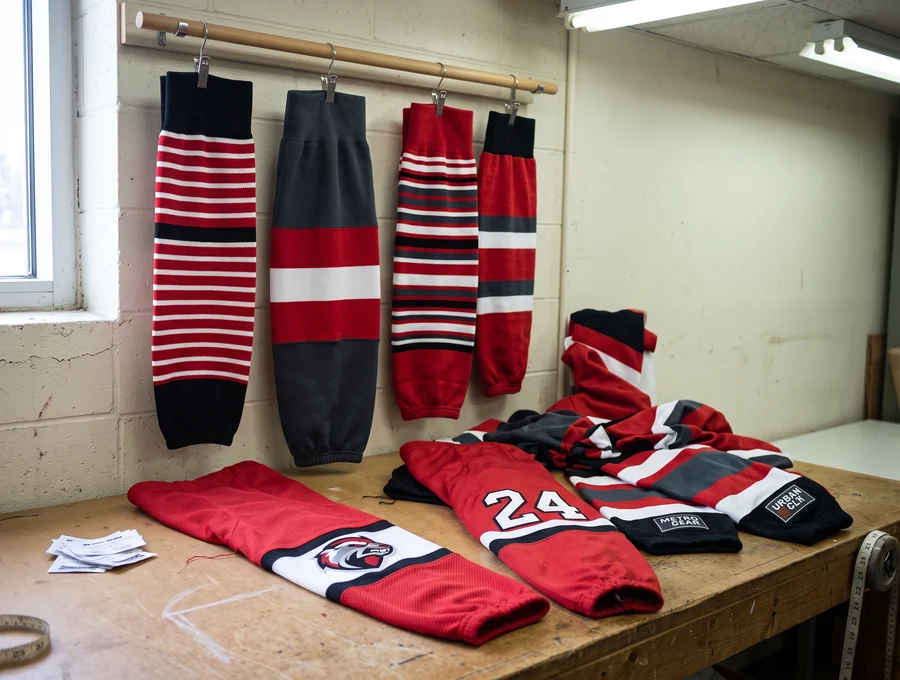
Many clubs hand the whole team set to a rink laundry service or a school equipment room, where the machines are larger and the cycles harsher. That works well if the people doing the washing have the same information you do. Give them the care label instructions, ask for low-temperature drying or no drying, and ask that socks go into mesh bags.
Before a set goes into an aggressive commercial cycle for the first time, look over the raised decoration. A twill edge that has started to lift, or a stitch that has come loose, gets much worse in one heavy wash and is easy to repair while it is small.
Store the Set Properly Between Seasons
End-of-season storage decides how the set looks when it comes out again. Wash every piece before it is stored, even jerseys that were only worn once, and make sure each one is completely dry. Hang jerseys on wide hangers or fold them flat with the numbers facing up, rather than folding sharply across a number or crest, since a hard crease across a heat-transfer number can crack it. Store the set in breathable bags or boxes, out of direct sunlight, and never in a sealed plastic bin if there is any chance the kit is still damp.
This is also the moment to count what you have. A club that knows exactly which sizes and numbers are missing or worn can plan a top-up long before the next season starts, rather than discovering the gaps at the first game. Coordinated hockey uniform programs are built so a single item can be replenished and still match the set.
A Quick Inspection After Each Wash Cycle
A thirty-second check as jerseys come off the hanger catches most problems early. Look at four places on each jersey: the twill or crest edges, the corners of pressed numbers, the neck opening, which is stretched over a helmet and pads every time the jersey goes on, and the underarm seams. On socks, check the seams where the leg meets the foot opening. Pull anything that needs repair out of the rotation before the next game instead of after it.
What to Ask Your Manufacturer Before the Order
Care starts before the first wash. If a set will be washed after nearly every session, say so in the inquiry, because it changes the fabric and the numbering route that make sense. The hockey jersey fabric guide explains which fabric directions suit heavy wash loads and how fabric is checked for shrinkage and colorfastness before it is cut.

If your program or league needs wash performance on paper, name the test standard when you order. Finished garments can go to a third-party laboratory for colorfastness, shrinkage and pilling tests under the standard you specify, with reports available on request. And ask for the care label to be sewn into every garment, so the instructions travel with the jersey to whoever ends up washing it.
When you are ready to plan a set, send the product, the decoration route, the roster with sizes and the date the kit is needed. Inquiries are answered within 12 business hours.